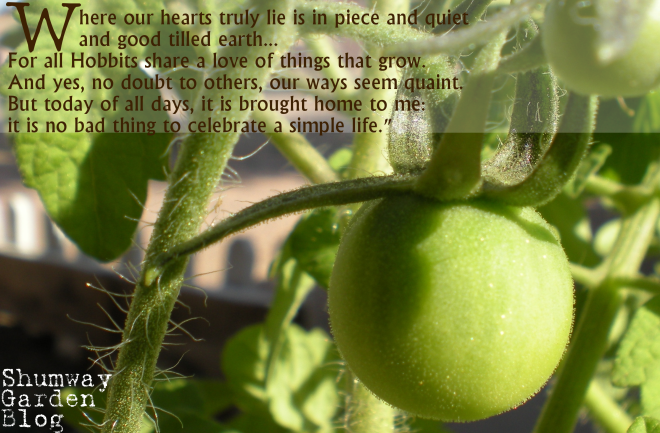
 This is a serious problem..... I have these tomatoes ripening left and right and they are soooo good. I'm actually quite surprised I love them so much because I'm not really a tomato person. and definitely not a cherry tomato person. I hate the feeling of the tomato bursting in your mouth. yuck. I do not like tomatoes in salad, but I do like a good tomato sliced thick with salt and pepper. mmmmm. these are perfect for that (even though they are small) they are so yummy with a little s&p. yay for the first veggies yielded from my delectable garden.
Showing posts with label food. Show all posts
Showing posts with label food. Show all posts
Wednesday, May 13, 2009
I CANT...STOP...EATING....
This is a serious problem..... I have these tomatoes ripening left and right and they are soooo good. I'm actually quite surprised I love them so much because I'm not really a tomato person. and definitely not a cherry tomato person. I hate the feeling of the tomato bursting in your mouth. yuck. I do not like tomatoes in salad, but I do like a good tomato sliced thick with salt and pepper. mmmmm. these are perfect for that (even though they are small) they are so yummy with a little s&p. yay for the first veggies yielded from my delectable garden.

Friday, October 3, 2008
Preparedness

"Dear Brothers and Sisters:
Our Heavenly Father created this beautiful earth, with all its abundance, for our benefit and use. His purpose is to provide for our needs as we walk in faith and obedience. He has lovingly commanded us to “prepare every needful thing” (see D&C 109:8) so that, should adversity come, we may care for ourselves and our neighbors and support bishops as they care for others. We encourage Church members worldwide to prepare for adversity in life by having a basic supply of food and water and some money in savings. We ask that you be wise as you store food and water and build your savings. Do not go to extremes; it is not prudent, for example, to go into debt to establish your food storage all at once. With careful planning, you can, over time, establish a home storage supply and a financial reserve. We realize that some of you may not have financial resources or space for such storage. Some of you may be prohibited by law from storing large amounts of food. We encourage you to store as much as circumstances allow. May the Lord bless you in your home storage efforts. "
-The First Presidency
Hi all. I thought I'd post a little about what is taking over my life lately. I have been really trying to get our house in order for calamities that are unavoidable. Bluntly put, but I'd rather not sugarcoat anything so you know how serious I am. I'm not scared, I just know it needs to get done. Every time we go shopping I get more canned food than I know what to do with. Any basic necessity I buy, I buy extra of. Yesterday I bought 4 deodorants. Aaron said, "Stephanie I have two already." I said, "I know, but wouldn't you be sad if you didn't have any?" I bought more soap when I saw it was on sale. I buy at least 10 of anything canned that's under 60 cents (as long as it's not canned peas, YUCK!!!). I am educating myself about emergency preparedness, alternative energy and gardening. Right now is the time to be planting your fall gardens. Use this chance to learn about gardening. Seeds should be part of your food storage. For Preparedness info, please look at http://www.iwillprepare.com/ , provident living section of lds.org and thanks, Hannah, for this link: http://safelygatheredin.blogspot.com/ .
If you are in the valley of the sun (Arizona) here are a few more resources you should look up:
Cheap water barrels:
Email Bill at Westinaz4@aol.com
Right now is the time to plant your fall garden! If you want to garden, I have a friend who will come and prepare your soil for you (for a fee)
Email Tom at thomaspbogle@gmail.com
If you'd like to attend an organic gardening class come to ASU East campus every other Saturday at 6:30am with $5 in your pocket and you'll learn a ton!
Email me if you're interested- demanieshs@yahoo.com
Every week, I will post a preparedness tutorial or tip. This week, it's about food storage breakfasts:

(From Sandy Leonard in my ward)
"I recently read from a newscaster his suggestions on storing food for a couple of months and his idea was to eat oatmeal every morning for breakfast. This is a good idea for a number of reasons:
1. The cannery sells oats already canned or you can can your own
2. I ate oatmeal as a child and as a teen almost every morning and I am still not tired of it
3. It is inexpensive
4. You can prepare it by soaking it overnight or by soaking it for a couple of hours in the morning rather than cooking it
5. You can add raisins, craisins, blueberries, banana chips, cinnamon, honey, etc. for variety
I purchase oat groats from Sprouts @ 79 cents/lb & soak them 1/2 C oat groats: 3/4 C water, or less. Before eating I add cayenne pepper, sea salt to taste, flax oil, & soaked seeds, i.e. sunflower, flax, sesame, etc. It is filling, healthy, and inexpensive.
It is good to eat small portions of food throughout the day rather than one big meal once a day. I have sooo much energy when my last meal is @ 4:00pm then my body can fully digest what I have eaten for the day rather than being overtaxed in digesting food all through the night. Less food versus more food = energy if it is nutritious food."
"I recently read from a newscaster his suggestions on storing food for a couple of months and his idea was to eat oatmeal every morning for breakfast. This is a good idea for a number of reasons:
1. The cannery sells oats already canned or you can can your own
2. I ate oatmeal as a child and as a teen almost every morning and I am still not tired of it
3. It is inexpensive
4. You can prepare it by soaking it overnight or by soaking it for a couple of hours in the morning rather than cooking it
5. You can add raisins, craisins, blueberries, banana chips, cinnamon, honey, etc. for variety
I purchase oat groats from Sprouts @ 79 cents/lb & soak them 1/2 C oat groats: 3/4 C water, or less. Before eating I add cayenne pepper, sea salt to taste, flax oil, & soaked seeds, i.e. sunflower, flax, sesame, etc. It is filling, healthy, and inexpensive.
It is good to eat small portions of food throughout the day rather than one big meal once a day. I have sooo much energy when my last meal is @ 4:00pm then my body can fully digest what I have eaten for the day rather than being overtaxed in digesting food all through the night. Less food versus more food = energy if it is nutritious food."
INVITATION TO EVERYONE READING THIS IN DRIVING DISTANCE OF GILBERT, AZ
Families Safely Gathered In
 Higley Stake Preparedness Fair
 November 1, 2008
7:00 – 10:00
Pancake breakfast from 7-8:30 booths open til 10
In the LDS Chapel parking lot on Recker & Warner
Featuring:
· Menus & recipes for 3-month emergency storage
· Gardening
· Herbs and their uses
· First aid
· Long and short term water storage
· Fingerprinting & DNA kits
· Integrating the cannery in daily living – menus & recipes
· Food preservation methods
· Solar cooking and fuel storage
· Humanitarian displays
· And more . . . .
Sunday, September 21, 2008
SPROUTS!
 "Wanted! A vegetable that will grow in any climate, will rival meat in nutritive value, will mature in 3 to 5 days, may be planted any day of the year, will require neither soil nor sunshine, will rival tomatoes in Vitamin C, will be free of waste in preparation and can be cooked with little fuel and as quickly as a ... chop." -Dr. Clive M. McKay, Professor of Nutrition at Cornell University.
 Dr. McKay was talking about sprouts. (To see the wonderful nutritional value of Sprouts, see sprout info below the tutorial)
I'm going to teach you all how to sprout alfalfa seeds in your kitchen! It's awesome! My daughter eats sprouts on everything now. She even asked for some on her scrambled eggs the other morning which I hesitated at at first, but heck, why not? She finished the sprouts and left some of the eggs unfinished. LOL I have felt so good since I made these sprouts part of my daily diet, so naturally I want to share the wealth!
First, you need:
-Alfalfa Seeds
-2 Quart Wide Mouth Jar (I recycled a large Mott's applesauce jar)
 -a mesh strainer * (I did my first batch without this, but it's easier with it)
-water
Place 1-2 Tbs alfalfa seed in a 2 quart wide-mouth jar & cover w/water overnight.

The next day, pour off water using a small mesh strainer& rinse the seeds. Drain off any and all excess water so seeds will not spoil. After everY rinse, lay jar on it's side and spread the seeds out as much as you can with a butter knife.

For the next few days, keep seeds rinsed to keep them from drying out, straining after each rinse making sure all excess water is removed and lay back on it's side. (I just do this whenever I come into the kitchen)

About the fourth day the seeds begin to sprout white tails. Place them in the sunlight for a day or two so they will turn green in color. **to have them sprout after 1 day see my note below

 Once sprouts are about an inch long, or after one week, place moist green sprouts in an airtight bag or container and put them in the fridge for keeping.
Sprouts should be used within 5 days.
Sprouts can be used in soups, on steamed veggies, as lettuce for sandwiches, burros, baked potatos, and salads. They are full of vitamins, minerals, and live enzymes.
The above suggested amount will give you a 2 quart jar full of sprouts.
*Some people like to take a piece of nylon and a rubberband to cover the jar so that you can strain the sprouts easily
** in the initial soak I add a few drops of kelp (you can get this at most gardening stores- it's great for helping plants in distress such as transplant shock as well.) I also keep them in the sunlight from the very beginning. I think a combination of the two has made it so my alfalfa sprouts after about 30 hours instead of the 4 days stated.
SPROUT INFO
It is really only in the past thirty years that "westerners" have become interested in sprouts and sprouting. During World War II considerable interest in sprouts was sparked in the United States by an article written by Dr. Clive M. McKay, Professor of Nutrition at Cornell University. Dr. McKay led off with this dramatic announcement: "Wanted! A vegetable that will grow in any climate, will rival meat in nutritive value, will mature in 3 to 5 days, may be planted any day of the year, will require neither soil nor sunshine, will rival tomatoes in Vitamin C, will be free of waste in preparation and can be cooked with little fuel and as quickly as a ... chop."
Dr. McKay was talking about sprouts. He and a team of nutritionists had spent years researching the amazing properties of sprouted soybeans. They and other researchers at the universities of Pennsylvania and Minnesota, Yale and McGill have found that sprouts retain the B-complex vitamins present in the original seed, and show a big jump in Vitamin A and an almost unbelievable amount of Vitamin C over that present in unsprouted seeds. While some nutritionists point out that this high vitamin content is gained at the expense of some protein loss, the figures are impressive: an average 300 percent increase in Vitamin A and a 500 to 600 percent increase in Vitamin C. In addition, in the sprouting process starches are converted to simple sugars, thus making sprouts easily digested.
One pound of alfalfa seed will yield 10-14 pounds of fresh mini-salad greens. Whether you are on top of a mountain or in a bunker with artificial light, you can still grow this fast, organic food.
Yes, it is fast food, but you won't be sacrificing any nutrition. Alfalfa sprouts have more chlorophyll than spinach, kale, cabbage or parsley. Alfalfa, sunflower, clover and radish sprouts are all 4% Protein. Compare that to spinach - 3%, Romaine lettuce -1.5% and Iceberg lettuce- 0.8%, and milk -3.3%. These foods all have about 90% water. But meat and eggs are the protein foods for Americans. Meat is 19% and eggs are 13% protein (and 11% fat). But Soybean sprouts have 28% protein, and lentil and pea sprouts are 26%. Soybeans sprouts have twice the protein of eggs and only 1/10 fat the fat.
Alfalfa, radish, broccoli, clover and soybean contain concentrated amounts of phytochemicals (plant compounds) that can protect us against disease. Canavanine, an amino acid analog present in alfalfa, demonstrates resistence to pancreatic, colon and leukemia cancers. Plant estrogens in these sprouts function similarly to human estrogen but without the side effects. They increase bone formation and density and prevent bone breakdown (osteoporosis). They are helpful in controlling hot flashes, menopause, PMS and fibrocystic breasts tumors.
The sprouts contain 10-100 times higher levels of these enzymes than do the corresponding mature plants.
Alfalfa sprouts are one of our finest food sources of saponins. Saponins lower the bad cholesterol and fat but not the good HDL fats. Animal studies prove their benefit in arteriosclerosis and cardiovascular disease. Saponins also stimulate the immune system by increasing the activity of natural killer cells such as T- lymphocytes and interferon. The saponin content of alfalfa sprouts multiplies 450% over that of the unsprouted seed. Sprouts also contain an abundance of highly active antioxidants that prevent DNA destruction and protect us from the ongoing effects of aging. It wouldn't be inconceivable to find a fountain of youth here, after all, sprouts represent the miracle of birth.
Subscribe to:
Posts (Atom)

 Posts
Posts


